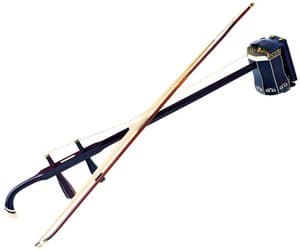
Erhu
The erhu has a hollow wooden cylindrical body with a snake skin sounding board, two strings and bow inserted between them. It has a mellow tone quality. Erhu was played with a bow instead of a bamboo stick during the Song Dynasty (960–1279).
Explore the traditional Chinese instruments taught at CCMDA and discover the unique sounds, techniques, and cultural heritage behind each one.
✦
Huqin is the general term for all the Chinese bowed-string instruments. There are more than thirty-six types of Huqins: Erhu, Gaohu, Zhonghu, Gehu, Bass Gehu, Matoqin, Si-strings Hu, and more.
The erhu has a hollow wooden cylindrical body with a snake skin sounding board, two strings and bow inserted between them. It has a mellow tone quality. Erhu was played with a bow instead of a bamboo stick during the Song Dynasty (960–1279).
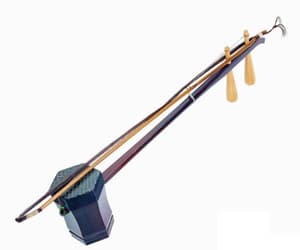
Also known as yuehu, has the same shape as the erhu, with its tubular resonator smaller, a fourth or fifth higher in tuning than erhu. It has a sonorous and glamorous tone.
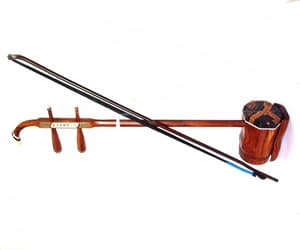
Also known as alto erhu, larger dimensions in the neck and resonator, a fourth or fifth lower in tuning than erhu. It has a deep and gloomy tone.
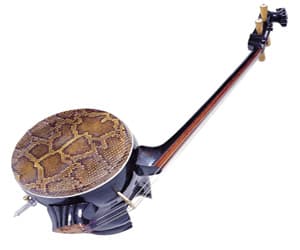
It has four strings, has a deep and mellow tone. Its four strings are tuned in fifths. It has a horizontal round tubular resonating chamber.
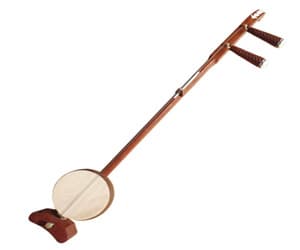
The banhu is a Chinese traditional bowed string instrument in the huqin family of instruments. It is used primarily in northern China. Ban means a piece of wood and hu is short for huqin.
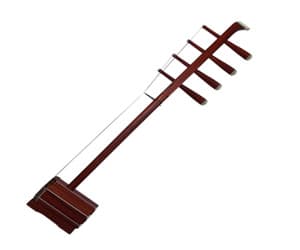
The sihu is a Chinese bowed string instrument with four strings. It is a member of the huqin family of instruments.
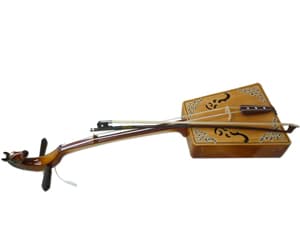
The instrument consists of a trapezoid wooden-framed sound box to which two strings are attached. It is held nearly upright with the sound box in the musician's lap or between the musician's legs.
Plucked-string instruments have a long history in China. Played with the fingers or a plectrum, or with bamboo sticks by hitting the strings. There are more than forty kinds: Guzheng, Pipa, Zhongruan, Ruan, Sanxian, Yueqin, Liuqin, Honghou and more.
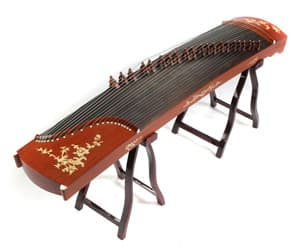
Guzheng is also called Zheng or Long Zither. It is a plucked half-tube zither with 21 to 26 strings. It has a unique, rich expressiveness and is played with diverse finesse and outstanding character imparting string flavours.
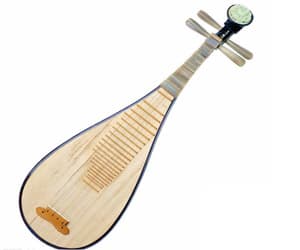
Pipa is a pear-shaped, lute-like instrument with four strings. The pipa has a rich expressiveness tone and is played with demanding techniques.
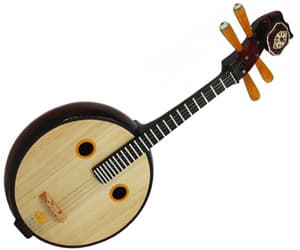
Ruan comes in different sizes: small-sized, medium-sized, large-sized, and bass ruans. It is a kind of pipa with a long neck. Ruan had 8 frets in ancient times, but nowadays it is equipped with 4 strings and 24 frets. The alto and tenor Ruan are commonly used. Mellow in tone quality.
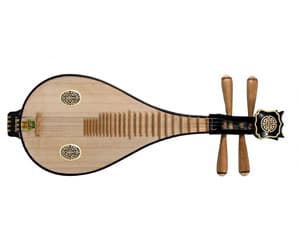
It has a willow-leaf shaped sound box, four strings, and 24 frets arranged in half-step intervals. Also called tu pipa and popular in Shandong. The front side is made of tung wood and the reverse side of red sandalwood. It has a clear and bright tone.
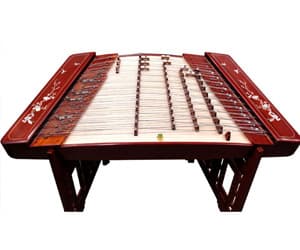
Yangqin is also called butterfly-qin and dulcimer. It came from Persia and Arabia at the end of the Ming dynasty (1368–1644). It has a crisp tone with wide tonal ranges. It is an important accompanying instrument as well as a solo instrument.
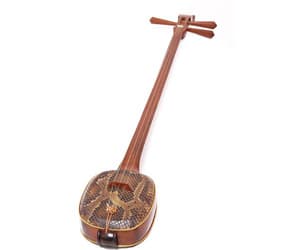
The sanxian is a Chinese lute — a three-stringed fretless plucked musical instrument. It has a long fingerboard, and the body is traditionally made from snakeskin stretched over a rounded rectangular resonator.
Wind instruments are sounded by passing an air-stream through a pipe: through holes (Di, Xiao, Xun); with a double-reed (Suona, Guan); or with a reed (Sheng, Bawu, Hulushi). The tones are all different with different playing techniques.
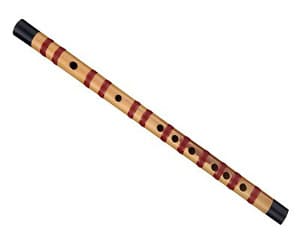
Dizi is a bamboo flute. It has a membrane over an extra tone hole to give the rattle effect of the Chinese flute.
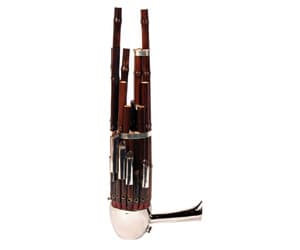
The sheng is made up of three components: the Sheng body, sounding pipe, and reed. As its shape looks like the phoenix wings, it was also known as fongsheng.
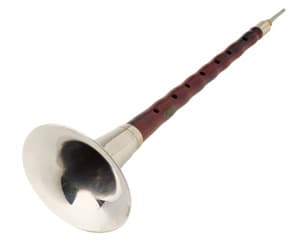
Suona came from Persia and Arabia in the Jin Dynasty and Yuan Dynasty. It was firstly used in the army to inspire the soldiery. Later it has been used by people in all social and entertainment functions.
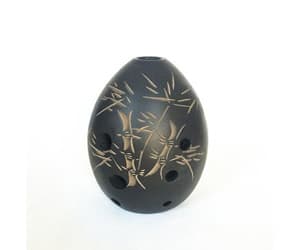
Xun is a vessel flute. It is made of clay or porcelain in the shape of a goose egg or mound with the blowing hole on the top, usually five or six finger holes on the sides.
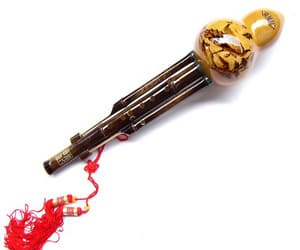
The hulusi is a free reed wind instrument from China. It is held vertically and has three bamboo pipes which pass through a gourd wind chest; the center pipe has finger holes and the outer two are typically drone pipes.
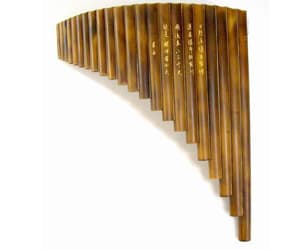
The paixiao is an ancient Chinese wind instrument, a form of pan pipes. It is no longer used, having died out in ancient times, although in the 20th century it was reconstructed.
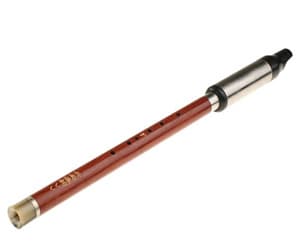
The bawu is a Chinese wind instrument. Although shaped like a flute, it is actually a free reed instrument with a single metal reed. It is played in a transverse manner and has a pure, clarinet-like timbre with much ornamentation, particularly bending tones.
Percussion instruments are played by striking them with another object. In China, percussion instruments have a long history. Metal types: gong, cymbals, yunluo, bells, and chimes; bamboo/wood types: clappers, banzi, muyu; skin types: dagu (large barrel drum), paigu (a set of tuned drums), hand drums.
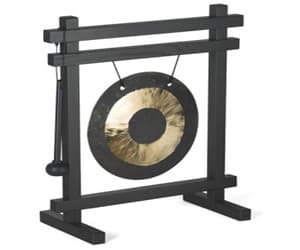
The luo is a gong available in different sizes and is struck by a wooden mallet.
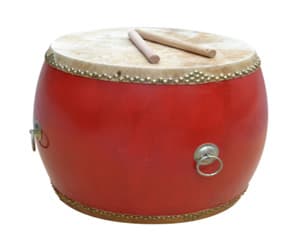
Its wooden shell is covered with drumheads of cowhide. It is struck with a pair of wooden beaters. Tone quality can be modified by moving the point of striking closer to the centre of the surface.
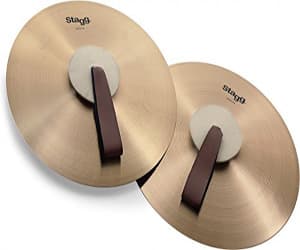
The performer, with one piece in each hand, strikes the pair together. It is one of the four major instruments in the jubilant luogu (gong and drum) music.
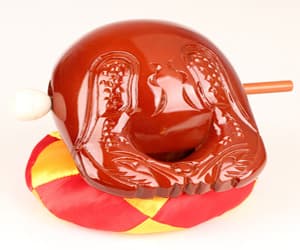
The muyu is a carved, hollow, wooden instrument, usually referred to as a 'wooden fish'. It is mainly used for regular rhythms in the accompaniment.
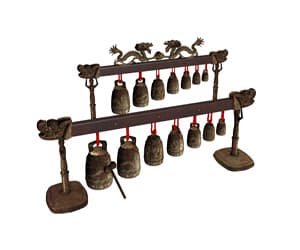
Bianzhong is an ancient Chinese musical instrument consisting of a set of bronze bells, played melodically. The bells were hung in a wooden frame and struck with a mallet.
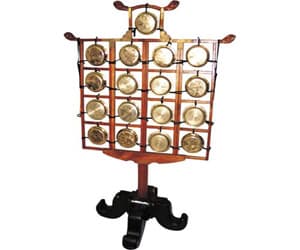
The yunluo is a set of usually ten small tuned gongs mounted in a wooden frame, with each gong being about 9–12 cm in diameter and the height of the frame being about 52 cm.
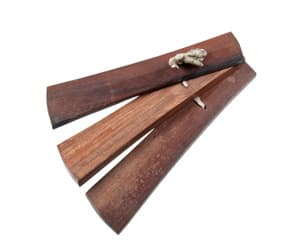
The paiban is a clapper made from several flat pieces of hardwood or bamboo, which is used in many different forms of Chinese music. There are many different types of paiban.